

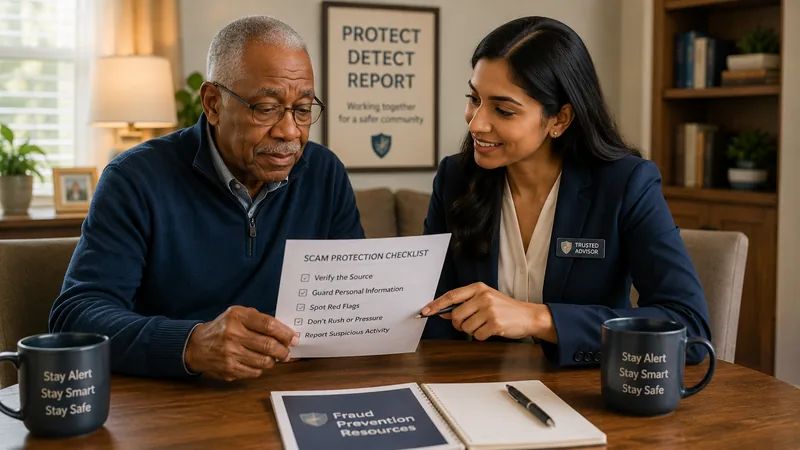
The Five-Minute Rule: How to Stop a Phone Scam Before It Starts
Almost every phone scam depends on one thing: speed. Take five minutes, and the whole thing falls apart.
- Estimated reading time
- 4 minutes
- Written by
- Sherri Combs
- Published
- July 28, 2026
Why scammers are always in a hurry
A scammer's script is built to keep you from thinking. The story is urgent — a grandchild in jail, a warrant, a frozen account, a package that cannot be delivered. Urgency is not evidence. It is the tool.
Real institutions do not lose patience when you say you will call them back. Banks, Medicare, the IRS, and law enforcement all expect you to verify. Only a criminal needs your answer right now.
“If a caller will not let you hang up and call back, you already have your answer.”
The five-minute rule
Whenever a call, text, or email asks for money, gift cards, account numbers, or a code from your phone, stop everything for five minutes. Hang up. Do not use any number the caller gives you. Look up the organization yourself and call the number printed on your statement, your card, or their official website.
Five minutes is long enough for the adrenaline to fade and for your own judgment to come back. That is exactly why scammers work so hard to prevent it.
Three sentences worth memorizing
“I don't make decisions on the phone.” “I'll call you back at the number I have on file.” “I need to talk to my family first.” Say any one of them and a legitimate caller will simply agree. A scammer will argue — and that argument is your confirmation.
Keep this by the phone
- Never give account numbers or codes to an incoming caller
- Hang up and call back on a number you looked up yourself
- No legitimate agency asks for gift cards
- Tell one family member about every unusual call
- Report attempts at reportfraud.ftc.gov
Being cautious is not being rude, and being scammed is never a sign of weakness. These scripts are written by professionals. The five-minute rule simply takes away the one advantage they have.
Quick Questions
What if the caller ID shows my bank's real name?
Caller ID can be faked in seconds. Treat the number on your screen as a guess, not proof, and call your bank back on the number from your card.
Learn more in: More fraud prevention guides
I already gave out information. What now?
Call your bank right away, freeze your credit with all three bureaus, and report it at reportfraud.ftc.gov. Acting quickly limits the damage.
Learn more in: Steps after a scam
About the Author

Sherri Combs
Founder & CEO, Silver Streak Senior Services™
Sherri writes about senior safety, fraud awareness, and the practical side of aging with dignity.
Related Silver Streak Articles
Trusted Resources
- Fraud Prevention
- Phone Scams
- Senior Safety
- Elder Fraud